
Voice project guide

Using narakeet for voice generator work

A voice generator can read a script, but a useful recording starts with a clear brief. Use this guide to prepare the words, test the delivery, and decide whether the result suits your audience.

Continues to a partner site
Narakeet voice and video creation imagery

What this scenario must deliver

For narakeet for voice generator projects, the deliverable is more than spoken text. Each listener needs an intelligible message, appropriate pacing, and a version that fits its destination.

Course creator

Turn a short lesson into narration that follows the order of the on-screen explanation.

A listener can follow the lesson without having to reread each slide. For broader narration planning, see narakeet for ai voice.

narakeet for ai voice
Product marketer

Prepare a voiceover for a demonstration with a tight opening and a clear closing action.

The recording makes the product name and next step easy to hear. For a generator-focused brief, see narakeet for ai voice generator.

narakeet for ai voice generator

Internal trainer

Read a process update aloud while keeping unfamiliar terms and acronyms understandable.

Colleagues hear the same sequence of instructions without guessing at terminology. For voice selection context, see narakeet for ai voice.

narakeet for ai voice

Video editor

Draft narration in sections so changes to one scene do not force a rewrite of the whole script.

Each scene has a concise read that can be checked against its visuals. For generator workflow ideas, see narakeet for ai voice generator.

narakeet for ai voice generator

Each item

Treat each part of the brief as a separate check. A polished voice cannot rescue a script that leaves out the name, instruction, or context the listener needs.

One idea per spoken segment

Write the lesson in short passages that match the visual sequence. Read numbers and abbreviations aloud before testing them in a voice generator; what looks obvious on a slide may sound ambiguous without it.

  • State the learning point before the detail.
  • Mark where a diagram needs time to be seen.
  • Check that the last sentence leads into the next section.

Name the benefit before the feature list

Open with the problem the product addresses, then give the viewer a concrete reason to keep watching. Keep model names, brand names, and calls to action together in the script so they are easy to verify in the generated read.

  • Put the product name in a natural sentence.
  • Avoid packing several claims into one breath.
  • Listen for a closing line that sounds complete.

Make instructions hard to mishear

For internal announcements, clarity matters more than dramatic delivery. Spell out an acronym on first use, separate dates from deadlines, and check whether a listener can identify the requested action after a single play.

  • Identify the audience and owner of the action.
  • Say dates and quantities unambiguously.
  • Finish with the next step, not background detail.

Quality bar

Use this side-by-side checklist when judging a first voice generator draft. The right column describes what to listen for, not a feature or output guarantee.

Draft to revise Ready for review
1

Opening

Draft to revise

Starts with background the listener does not need.

Ready for review

States the topic or purpose promptly.

2

Sentence length

Draft to revise

Several ideas compete in one long sentence.

Ready for review

One main idea is easy to follow at a time.

3

Names

Draft to revise

Brand or person names are left unchecked.

Ready for review

Important names are heard and verified.

4

Numbers

Draft to revise

Dates or quantities could be interpreted two ways.

Ready for review

The intended meaning is clear when spoken.

5

Pacing

Draft to revise

Transitions run into the next point.

Ready for review

Listeners have time to absorb each point.

6

Ending

Draft to revise

The read stops without a clear conclusion.

Ready for review

The final line resolves the message or action.

Common rework

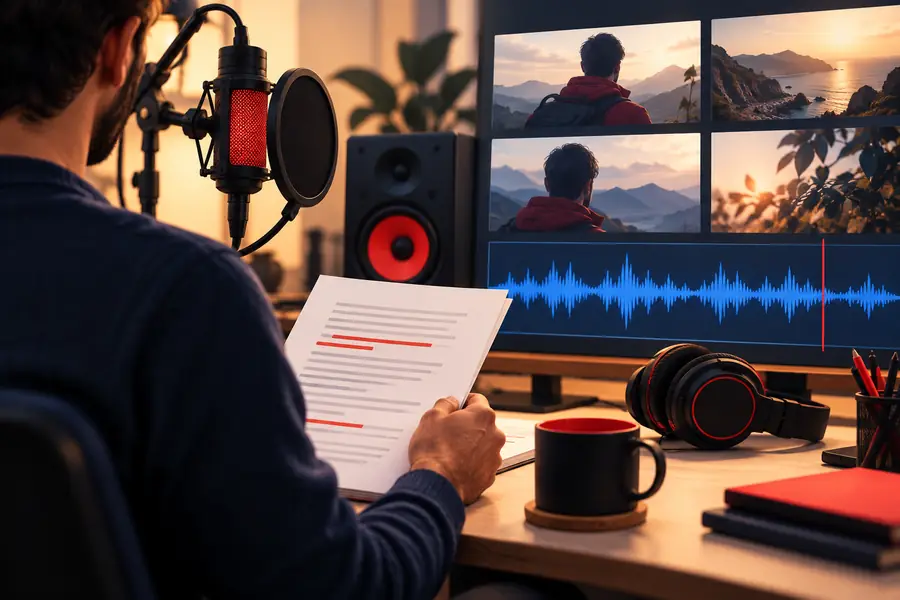
A frequent revision is moving from a document written to be scanned to a script written to be heard. The images illustrate that change in context, not a verified product transformation.

Source announcement

Illustration of an announcement presented as a document
Illustration of an announcement presented as a video preview
Narrated presentation

Before generating a voice, rewrite dense passages into spoken sentences. Then compare the recording with the source to catch missing facts, awkward emphasis, or a call to action that no longer makes sense.

Common rework: practical checks

These workflows isolate the part most likely to need another pass. Review the script and the recording separately so you know which one to change.

    • Script check

      Pronunciation pass

      Explore voice generation

      Execution sequence

      1. List words that must be pronounced clearly.
      2. Listen to each word in its full sentence.
      3. Revise the passage and repeat the check.

      Collect proper names, acronyms, and unusual terms before the first test. If a word sounds wrong, revise how that passage is written and listen again rather than assuming the audience will infer it.

    • Timing check

      Pacing pass

      Explore voice generation

      Execution sequence

      1. Play the narration alongside the visual.
      2. Mark sections where information arrives too quickly.
      3. Shorten the sentence or allow more space.

      Compare the read with the material it accompanies. A section that sounds fine alone may leave too little time to look at a chart, understand a scene, or follow a demonstration.

    • Listener check

      Final message pass

      Explore voice generation

      Execution sequence

      1. Listen once without pausing.
      2. Write down the message you heard.
      3. Revise any line whose meaning depends on the written text.

      Play the complete recording without looking at the script. Check whether the opening, central point, and requested next step are understandable to someone encountering the topic for the first time.

    Common rework: make the next test count

    Bring a clearer brief to your next voice test

    If you are exploring narakeet for voice generator work, start with a short script and one listening goal. Check the partner site's current capabilities and terms before relying on any particular voice, format, or usage permission.

    • Write for listeners rather than readers
    • Check names, numbers, and pacing
    • Review the complete message before publishing

    Scenario FAQ

    Prepare a short script, identify its audience, and mark names or numbers that must be clear. Also decide where the recording will be used so you can judge pacing against the surrounding material.

    Listen while watching the video rather than judging the voice in isolation. Check whether each sentence arrives when its visual appears and whether viewers have time to understand both.

    Start with the script: split long sentences, replace written shorthand, and make transitions explicit. Test the revised passage in context before changing the rest of the project.

    No. Listen for pronunciation, missing words, ambiguous numbers, and a clear ending, then check the applicable usage terms for the service you choose.

    Create audio
    Create audio